
On 8 March, 2026, Delogue deployed an important infrastructure fix addressing the platform instability that some customers experienced recently.
This article provides a status update after the session architecture fix was released and explains what we are currently seeing in the platform performance metrics.
We want to be transparent about the platform status and make it easy to understand what has improved.
What was fixed on 8 March
The instability incidents experienced earlier were traced back to a session management component. A session is how the system remembers that you are logged in and keeps track of your activity while you work in Delogue, for example when you open styles, update data, or manage item lists.
In the previous architecture, session information could accumulate in the database. When enough sessions built up over time, this could lead to database locking, a situation where different system processes are waiting for each other to release access to data.
When these locks reached a certain level, the platform could slow down and become temporarily unresponsive.
On 8 March, we migrated the platform to a new session architecture designed to handle sessions in a much more scalable way. This significantly reduces the pressure on the database and prevents the accumulation that previously caused conflicts.
Importantly:
-
No security breach occurred
-
No data was lost
What we are seeing after the fix
Since the fix was released on 8 March, the platform has been stable.
We continuously monitor several system metrics that indicate the health of the platform. Three of the most important indicators are shown in the graphs below.
In all of these graphs, lower values indicate a healthier and more efficient system.
Server Workload (CPU Utilisation)
This graph shows how much processing capacity our servers are using.
Before 8 March, the servers often experienced spikes in workload as they attempted to handle the database conflicts created by the session component. After the fix was implemented, server utilisation dropped noticeably and became more stable, indicating that the system is now processing requests much more efficiently..png?width=670&height=224&name=Server%20Workload%20(CPU%20Utilisation).png)
Database Connections
Every action performed in Delogue, opening styles, saving changes, editing BOMs, or managing supplier information, requires communication with the database. This graph shows the number of active connections between the platform and the database.
Before the fix, these connections frequently increased to high levels, creating pressure on the system. Since 8 March, database activity has become significantly lower and more stable, which is a strong indicator that the session conflicts have been resolved.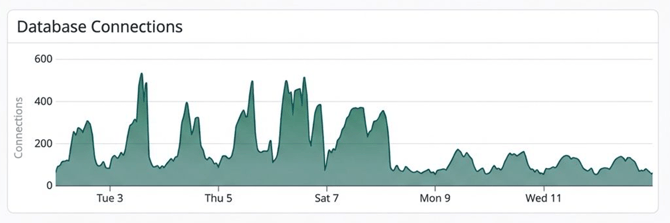
Time Spent Waiting for the Database
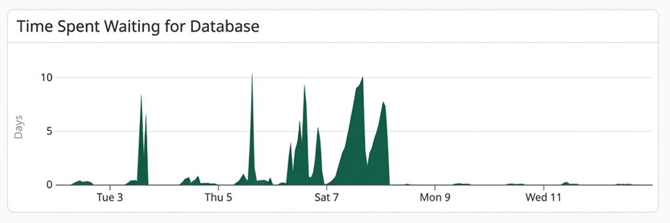
This metric shows how long the system must wait for the database to respond to requests.
Before 8 March, waiting times increased during periods of instability. After the fix, the waiting time has dropped close to zero, meaning the platform is able to process requests without delays.
What else we are working on
While one team has been focused on resolving the stability issue, other teams continue developing new features for the platform.
Upcoming releases currently in development include:
-
Bulk actions: allowing faster updates across multiple styles or items
-
Supply chain mappings and certification management: helping manage supplier compliance documentation
-
Public API 2.0: enabling stronger integrations with external systems
-
Role-based access control: providing more flexible permission management
These improvements will be released gradually with strengthened release governance to ensure platform stability remains the highest priority.